

What “IT” Spending and Downtime Numbers Mean for a Small Business
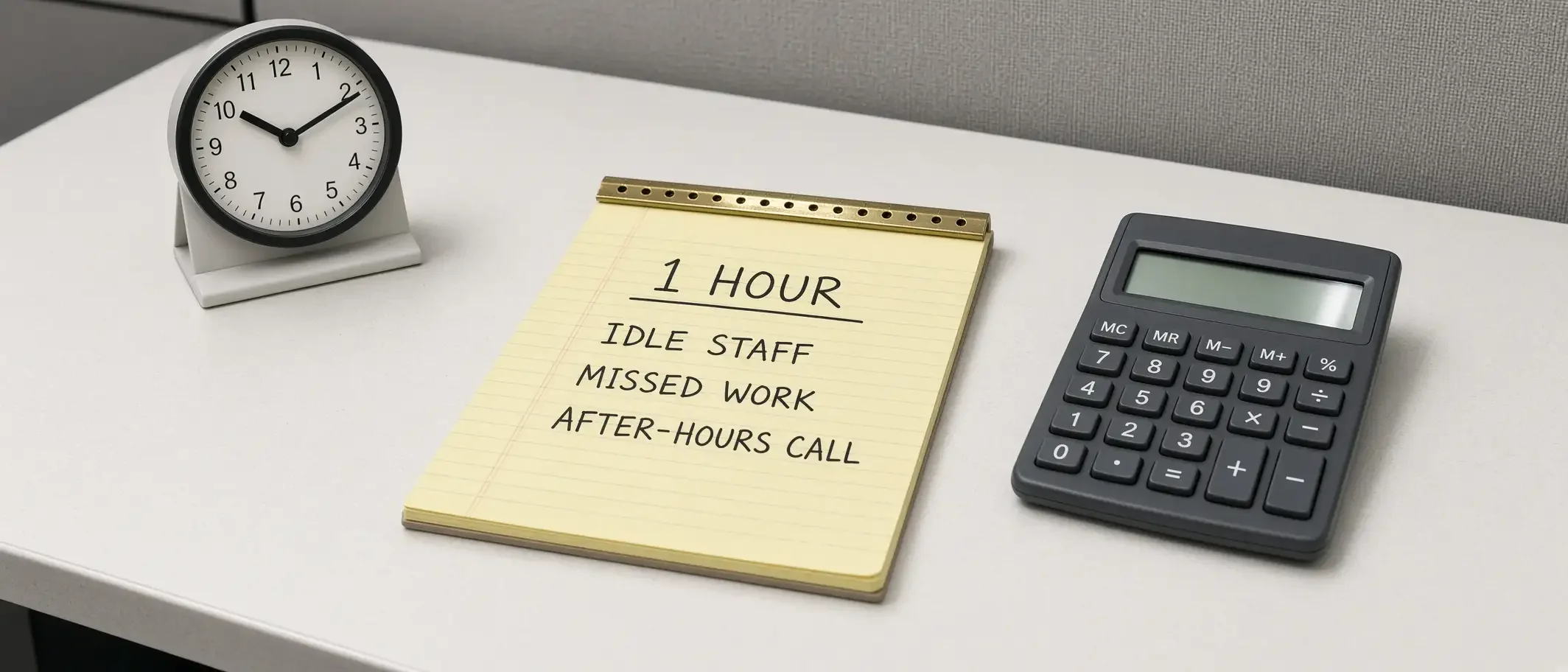
November planning decks like to quote a single scary figure. The one that still travels is Gartner’s 2014 average of $5,600 per minute of IT downtime. That number is real. It is also an old cross-industry average built mostly on larger organizations. It is not what a 25-person shop in Oak Ridge loses when the file share is down for forty minutes.
Use numbers that match your payroll and your invoices. The reports are useful when they tell you where to look. They are just noise when they become a slogan.
Price an hour of your own downtime
Take the people who cannot work if email, the practice system, or the shop floor terminal is down. Multiply headcount by a loaded hourly cost you already use for overtime or job costing. Add the emergency labor to get the system back. That is your hour.
A 20-person office at $50 loaded per hour loses $1,000 of labor in one idle hour before any missed invoice or patient visit. Four hours is a bad week. You do not need an industry average to decide whether monitoring and a spare firewall belong on the 2027 page.
The invoice is not the whole story
Software and telecom bills are the visible slice. Three quieter leaks show up in almost every year-end review.
Unused or wrong-sized licenses. Seats for people who left. A higher Microsoft 365 SKU than the job needs. After the July 1, 2026 commercial price change, Business Basic is $7 per user per month, and Business Standard is $14. Business Premium stayed at $22. Cleaning the roster before renewal often pays for itself.
Overlapping vendors. Two backup products. Two endpoint agents. A phone system that does not sit with the rest of the network, plus copper lines nobody uses. Each contract looks small. Together they are a line you can cut without a project.
Emergency labor. Break-fix work after a failure costs more per hour than the same work on a calendar. The premium is the surprise, not the technician.
What recent reporting actually supports
Worldwide IT spending kept rising in 2026. That tells you vendors will not make next year’s renewal cheaper by default. It does not tell you what your firm should spend.
License waste is common enough to audit every year. So is hardware that stays in service past reasonable service life because it still turns on. Cyber-insurance questionnaires that ask for MFA on email and remote access, endpoint detection on PCs and servers, and a dated backup restore test. Those are budget items if the controls are missing.
Ignore recycled claims that every SMB loses $5,600 a minute. Use your labor math.
Translate the numbers into five checks
Write your own downtime hour using headcount and loaded labor.
Export Microsoft 365 seats and cancel any that don't match current staff.
List every recurring IT vendor. Mark any two that do the same job.
List devices and UPS batteries out of warranty.
If you carry cyber insurance, put last year’s questionnaire next to the budget and mark every “no.”